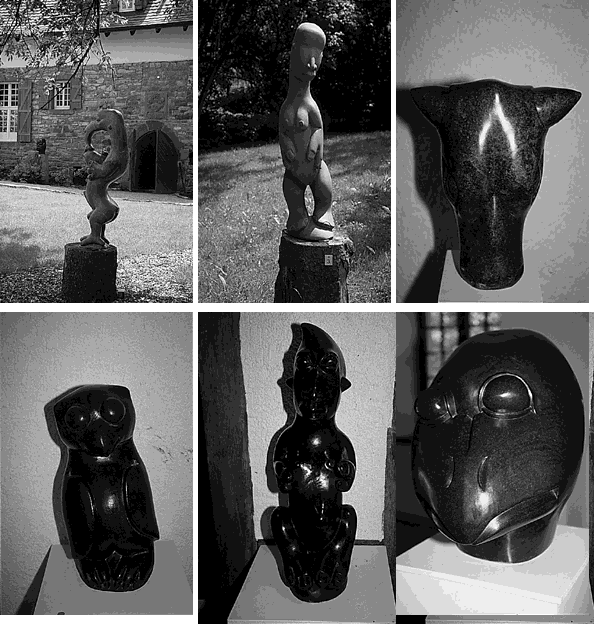
Bernard Matemera is acknowledged to be one of Zimbabwe's mastersculptors. Born in 1946 in the Northern district of Guruve, he hasspent his entire professional career at Tengenenge where he occupiesthe position of figurehead amongst the artists in the community.
International recognition and indeed a genuine appreciation in hisnative country has been hard won. As a child he showed great talentat wood carving and enjoyed traditional rural crafts such asmodelling clay, but as with many other of today's sculptors, it wasTom Blomefield and Tengenenge that provided him with the mostsignificant change in his life - an introduction to stone carving. Hequickly established an astonishingly individual and powerful style towhich he has remained true over many years of exploration, hardshipand success. His work has become so uncompromising, indeed demanding(especially of international audiences), that it often takes timebefore his strong African imagery and subject matter can beassimilated and understood. Animals, spirits, people and thecreatures which inhabit his dreams have faithfully provided him withsubject matter throughout his career. They demand attention, cannotbe ignored and remain with the viewer long after they havedisappeared from sight. His reluctance to discuss his work onlyserves to help the process of sending the sculptures out on their ownin the world, fully formed and capable of communicating in universallanguage of powerful, emotional, sexual, physical and culturallychallenging imagery. F. Mor, the author of Shona Sculpture, describesMatemera's work in the following terms, "His Africanneo-expressionism, often represented in enormous and deliberatelygrotesque dimensions, oscillates between the humorous and thetragic." Many of his subjects bear the mysterious physical trademarkof three toes and three fingers - a recurring element in the artist'sdreams, but an actual physiological fact amongst a community fromwhich he began as an artist (being one of only a few who remainedthroughout the war of Independence), but also consistently faithfulto his beliefs and sense of pride in his country with its inheritedcultural and spiritual ancestry. A respected critic of Zimbabweanstone sculpture, Celia Winter-Irving, writes about Matemera's workwith a deep understanding of the community in which it iscreated:
"There is in these sculptures an unspent power and a reserve ofenergy. They speak both of the force within them and the force behindthem. They are the product of great strength of mind as well asstrength of the hand; of a strength of will as well as a strength ofphysique. They are indeed a celebration of the monumental."
In the last few years he has received tremendous critical acclaimand international attention with the distinction of the prestigiousmajor award at the New Delhi Triennial in 1986, and significantinclusion in many important exhibitions since. He has won first prizein the Annual Heritage Exhibitions at the National Gallery ofZimbabwe and his work can be seen in many important collectionsthroughout the world.

